論壇回覆創建
-

恭喜!:f13::f17::f18::f19::emm01::emm04::emm02:
-
http://www.physics.csbsju.edu/astro/CS/CS.04.html
Term: altitude, vertical circle
Here at CSB/SJU the north celestial pole sits about 45° directly above the north point on the horizon. Thus the altitude of the north celestial pole is about 45°. Altitude describes the angle between the nearest part of the horizon and a star. Zenith has an altitude of 90° above every part of the horizon. The “line” (really part of a great circle) that goes straight down from the star to the horizon, and straight up through zenith and back down to the other horizon, is called a vertical circle. Vertical circles rise perpendicular to the horizon. Technically altitude is the angle along the vertical circle between the horizon and the star.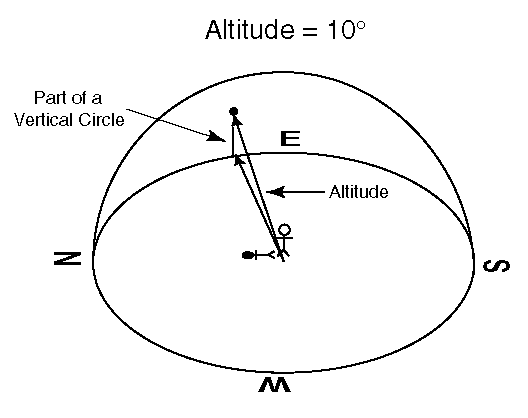
-
http://www.physics.csbsju.edu/astro/CS/CS.03.html
Term: celestial pole, zenith, meridian
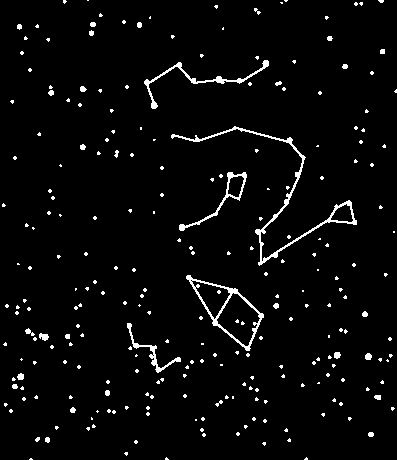
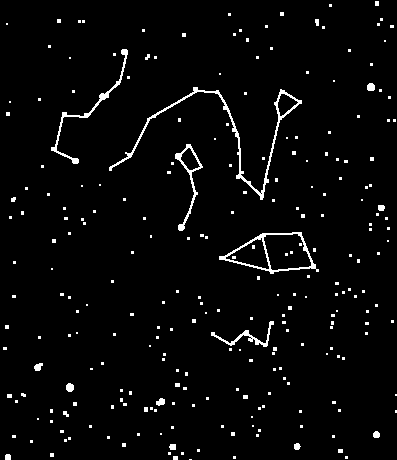
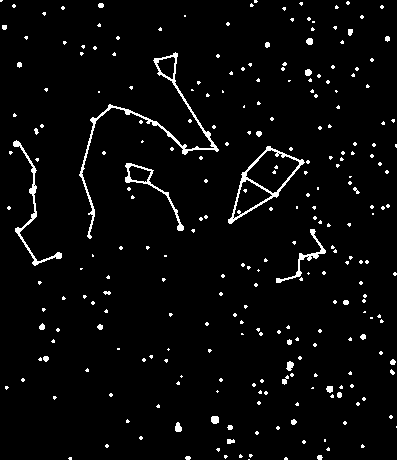
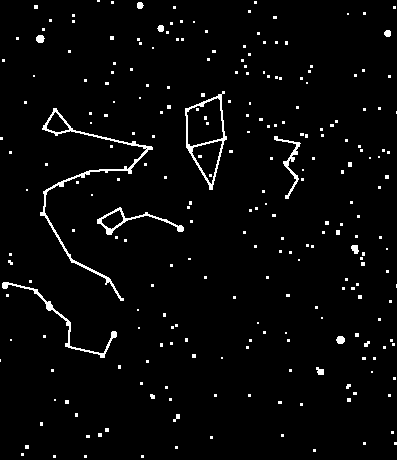
Did you notice that the tail of the Little Dipper (the star Polaris) remained fixed while the other stars just rotated around it? If not, go back and check.
What fraction of a rotation did the sky undergo in the 9 hours between 9 p.m. and 6 a.m.? go back and check!
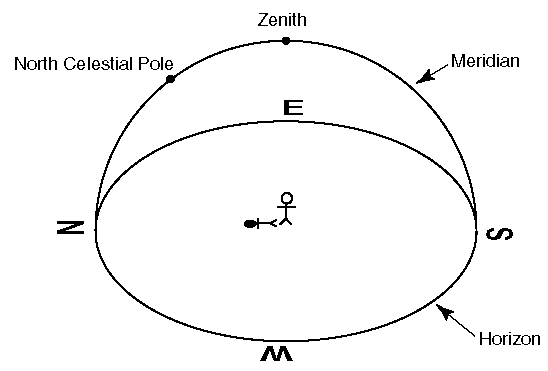
The points of rotation are called celestial poles. There is one at the north end of the celestial sphere (near the star Polaris) and one at the south end (not near anything in particular).The below picture shows where the north celestial pole is located in our sky. Here at CSB/SJU the north celestial pole sits about 45° directly above the north point on the horizon. The line that starts at the north point, goes through the north celestial pole through the point directly overhead and back to the south point on the horizon is called the meridian. We’ll also need a name for “the point directly overhead”; it’s called the zenith.
-
http://www.physics.csbsju.edu/astro/CS/CS.02.html
Term: celestial pole
The stars keep the same position relative to each other. For example, the stars forming the lip of the Big Dipper always point toward the tail star of the Little Dipper (which is the star Polaris). Thus we can consider the stars as attached to the dome of stars (celestial sphere). The fact that a star is not always in the same position in the sky tells us that the celestial sphere is not fixed overhead. It is moving. The motion of the celestial sphere in the sky is particularly simple. The fact that the motion is as simple as possible, was an attractive fact to the ancient Greek philosophers: it demonstrated design deserving an explanation.
Lets see if you can discover how the stars seem to move. Below find four pictures of the sky facing North, taken at 9 p.m., 12 midnight, 3 a.m., and 6 a.m. How are they related?