學習、詢問、尋找答案,向各方術數同好交流
與世界術數連接

術數社交學習平台討論區步天推晷[轉貼]Introduction to Spherical Astronomy

  • [轉貼]Introduction to Spherical Astronomy

    Posted by yfsum on 5 1 月, 2006 在 11:12 上午

    http://www.physics.csbsju.edu/astro/CS/CSintro.html

    Introduction to Spherical Astronomy
    Terms: celestial sphere, horizon
    If you go out in an open field on a clear night and look at the sky, you have no indication of the distance to the objects you see. A particular bright dot may be a airplane a few miles off, a satellite a few hundred miles off, a planet a many millions of miles away, or a star more than a million times further away than the most distant planet. Since you can only tell direction (and not distance) you can imagine that the stars that you see are attached to a the inside of a spherical shell that surrounds the Earth. The ancient Greeks actually believed such a shell really existed, but for us it is just a convenient way of talking about the sky.
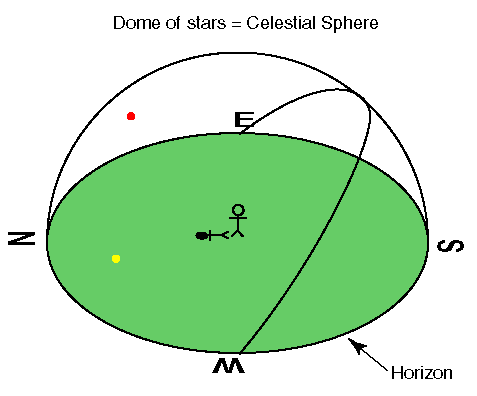
    In the below diagram I’ve placed a stick figure of a person in a green open field, and marked the cardinal directions on the horizon with the appropriate letters (NESW). Unless you live in Kansas, real horizons are partially obstructed, but we can imagine what the view would look like without the bell banner, etc. getting in the way. The horizon would then be a 360° circle where sky meets ground.

    Perspective drawing can be difficult to interpret (particularly when non-artists like me draw them). In the below drawing, I mean the red star to be on the far side of the dome, and hence a little above the NE horizon. The yellow star, on the other hand, I mean to be on the front side of the dome, and hence a bit above the NW horizon as viewed by the stick figure.
    Emma replied 20 年, 6 月 前 2 Members · 5 Replies
  • 5 Replies
  • yfsum

    會員
    5 1 月, 2006 在 11:14 上午

    http://www.physics.csbsju.edu/astro/CS/CS.01.html

    Terms: constellation, stick figure, magnitude
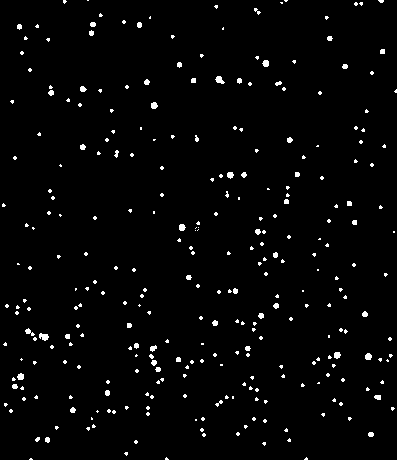
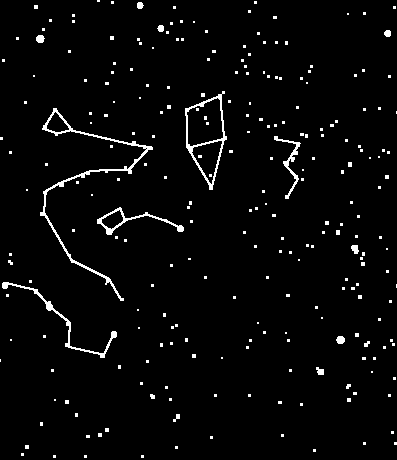
    The below drawing shows a piece of the celestial sphere (dome of stars) that you might see if you faced North at CSB/SJU.

    In this figure, stars that are brighter in the sky are shown as bigger white circles. (In fact, as seen from Earth all stars except the Sun just look like points of light, some of the points looks brighter than the rest because the star is unusually close or unusually bright.) Hipparchos (in the second century B.C.) called the brightest stars in the sky first magnitude stars, fairly bright stars (like those in the Big Dipper) second magnitude stars, etc. He called the dimmest stars he could see sixth magnitude stars That is, the brighter the star the smaller its magnitude. With telescopes we can now “see” stars much dimmer than sixth magnitude; very dim stars with magnitudes near 25 can now be measured.

    Since the stars in the sky are fairly randomly arrayed, it seems to be a rather difficult task to learn where certain stars are. The star Vega, for example, will be in the northwest on December nights, nearly overhead on August nights, and in the northeast on April nights. The process of learning the stars is made possible by the discovery that, while stars move around in the sky, they keep the same relationship to each other year after year. Thus the star Vega can be identified because it is the bright star that has a dim parallelogram of stars within 10° of it. The parallelogram of stars follows Vega around where ever it goes. We can then invent patterns of neighboring stars by imagining certain (bright) stars to be “joined”. The joined figures (stick figures of constellations) can then be learned separately from how one figure is positioned relative to another.

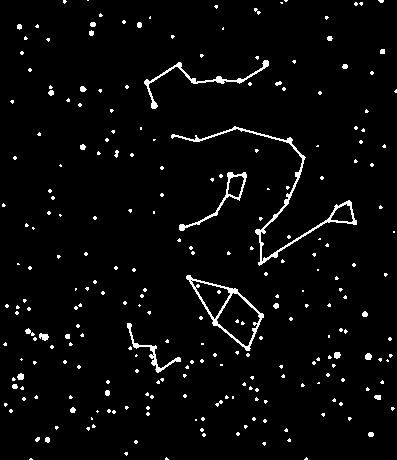
    Here we have (from top to bottom), the stick figures for the Big Dipper, Draco, the Little Dipper, Cepheus, and Cassiopeia. Can you find the Big Dipper in the first picture? Did you notice it before you saw the stick figure?

    Since different people see different stick figures in the sky, astronomers have developed a standard set of sky regions: the 88 official constellations cover the entire celestial sphere. The stick figures typically have the same sort of relationship to the official constellation as a highway map has with a country’s border. Just as a small town, while certainly part of some country, may not be on any highway map, so a dim star may not be a vertex of any stick figure, but it is certainly part of some constellation.

  • yfsum

    會員
    5 1 月, 2006 在 11:19 上午

    http://www.physics.csbsju.edu/astro/CS/CS.02.html

    Term: celestial pole
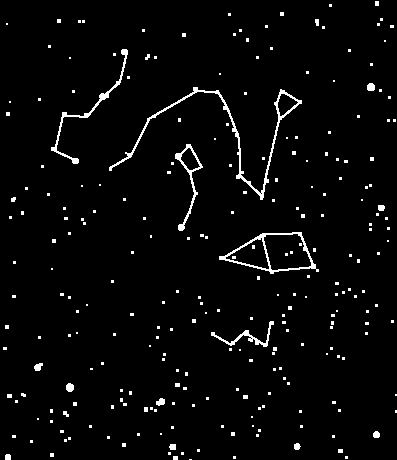
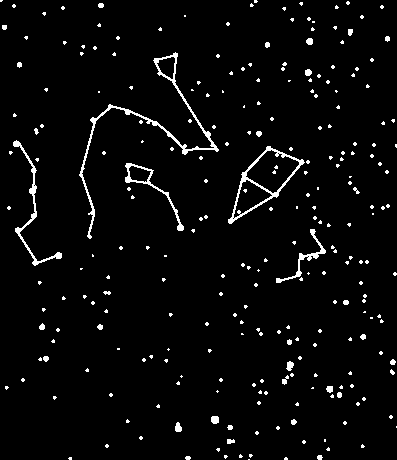
    The stars keep the same position relative to each other. For example, the stars forming the lip of the Big Dipper always point toward the tail star of the Little Dipper (which is the star Polaris). Thus we can consider the stars as attached to the dome of stars (celestial sphere). The fact that a star is not always in the same position in the sky tells us that the celestial sphere is not fixed overhead. It is moving. The motion of the celestial sphere in the sky is particularly simple. The fact that the motion is as simple as possible, was an attractive fact to the ancient Greek philosophers: it demonstrated design deserving an explanation.
    Lets see if you can discover how the stars seem to move. Below find four pictures of the sky facing North, taken at 9 p.m., 12 midnight, 3 a.m., and 6 a.m. How are they related?

  • yfsum

    會員
    5 1 月, 2006 在 11:20 上午

    http://www.physics.csbsju.edu/astro/CS/CS.03.html

    Term: celestial pole, zenith, meridian
    Did you notice that the tail of the Little Dipper (the star Polaris) remained fixed while the other stars just rotated around it? If not, go back and check.
    What fraction of a rotation did the sky undergo in the 9 hours between 9 p.m. and 6 a.m.? go back and check!
    The points of rotation are called celestial poles. There is one at the north end of the celestial sphere (near the star Polaris) and one at the south end (not near anything in particular).

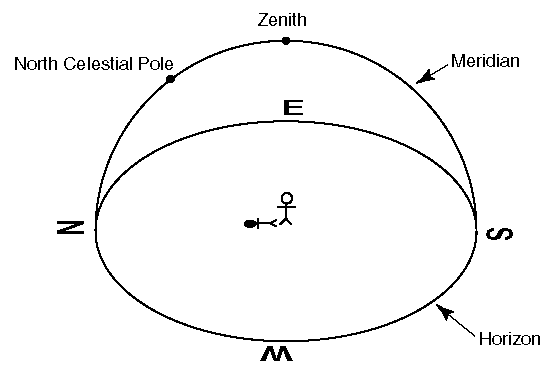
    The below picture shows where the north celestial pole is located in our sky. Here at CSB/SJU the north celestial pole sits about 45° directly above the north point on the horizon. The line that starts at the north point, goes through the north celestial pole through the point directly overhead and back to the south point on the horizon is called the meridian. We’ll also need a name for “the point directly overhead”; it’s called the zenith.

  • yfsum

    會員
    5 1 月, 2006 在 11:21 上午

    http://www.physics.csbsju.edu/astro/CS/CS.04.html

    Term: altitude, vertical circle
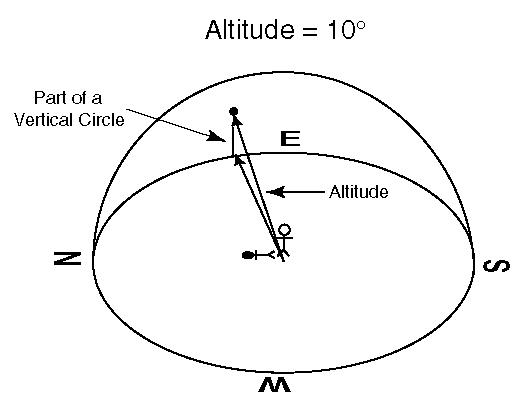
    Here at CSB/SJU the north celestial pole sits about 45° directly above the north point on the horizon. Thus the altitude of the north celestial pole is about 45°. Altitude describes the angle between the nearest part of the horizon and a star. Zenith has an altitude of 90° above every part of the horizon. The “line” (really part of a great circle) that goes straight down from the star to the horizon, and straight up through zenith and back down to the other horizon, is called a vertical circle. Vertical circles rise perpendicular to the horizon. Technically altitude is the angle along the vertical circle between the horizon and the star.

  • Emma

    會員
    6 1 月, 2006 在 4:50 下午

    :f17::f17::f17::f13:

Log in to reply.