


論壇回覆創建
-

:emm12: :emm11: :emm10: :emm08: :emm02: :emm04:
-
謝謝愛瑪!
:emm12: :emm23: :emm22: :emm02:
-
[ 這篇文章最後由yfsum在 2005/01/12 04:19pm 第 1 次編輯 ]
From: http://scidiv.bcc.ctc.edu/Math/Newton.html
Issac Newton
born: December 25, 1642 Woolsthorpe, England
died: March 20, 1727
I do not know what I may appear to the world; but to myself I seem to have been only like a boy playing on the seashore, and diverting myself in now and then finding a smoother pebble or a prettier shell than ordinary, whilst the great ocean of truth lay all undiscovered before me.
(Isaac Newton)CoÐinventor of calculus. Discovered the law of Universal Gravitation. Newton’;s 3 laws of motion. Corpuscular theory of light. Law of cooling. Professor, Theologian, Alchemist, Warden of the Mint.
Newton was a premature child and was very small at birth. His father had died before Newton’;s birth, and, when he was 3 years old, his mother remarried and left him in the care of his grandmother. He was somewhat sickly as a child, and since he could not join the other children in games he kept himself amused by building mechanical toys such as wooden clocks and sundials and a mouse-powered flour mill. He read a great deal and kept a journal of observations.
Newton began his schooling in the village schools and later was sent to Grantham Grammar School where he became the top boy in the school. At Grantham he lodged with the local apothecary and eventually became engaged to the apothecary’;s stepdaughter, Miss Storey, before he went off to Cambridge University at the age of 19. But Newton became engrossed in his studies, the romance cooled and Miss Storey married someone else. It is said he kept a warm memory of this love, but Newton had no other recorded ‘;sweethearts’; and never married.
In 1661, Newton entered Trinity College, Cambridge as a student who earned his expenses by doing menial work. Not much is known of his college days, but his account book seems normal enough — it mentions several tavern bills and two losses at cards. He received his B.A. degree in 1664, the year that the bubonic plague was sweeping Europe. The colleges closed for what turned out to be two years, so Newton returned to Woolsthorpe to think.
Up until then Newton had been somewhat precocious and had been a successful student, but he had done nothing really outstanding. Now things started to happen. His two years at Woolsthorpe represent the greatest recorded achievement of a human intellect in a short period. In these two years, this ‘;kid’; extended the binomial theorem, invented calculus, discovered the law of universal gravitation and had enough time left over to experimentally prove that white light is composed of all colors. Then he had his 25th birthday. If Newton had communicated these results and then died, his reputation would be almost a great as it is today. He lived for another 60 years and made a few additional contributions to the pool of knowledge, but, at most, these later results would have earned him a footnote in history. In two years he invented the calculus which would quickly grow into the largest and most important field in mathematics and which would first have a tremendous impact on physics and astronomy and more recently on fields of biology, economics, business and even political science. At the same time he discovered the law of universal gravitation which explains, on a large scale, how the universe operates.
When the plague subsided and the schools reopened in 1667, Newton returned to Trinity College as a Fellow (professor), and 2 years later Dr. Isaac Barrow, Newton’;s teacher, resigned so Newton could become Lucasian Professor of Mathematics. He was now 26, and from here on it was mostly downhill, at least intellectually. Newton lectured on optics and calculus and physics; he built telescopes and observed Jupiter’;s moons, and calculated orbits. But these areas became secondary interests. His heart was really in alchemy (“lead into gold,” the forerunner of chemistry) and theology and the spiritual universe. He attempted to reconcile the dates of the Old Testament with historical dates, became very involved with astrology and attempted to contact departed “souls.” In hindsight, it is easy to dismiss all of this as nonsense, but these were serious attempts of a serious man to understand the entire universe. It is unfortunate, however, that Newton devoted so little of the rest of his life to mathematics and physics. The few times he did return to these areas, he proved that he had not lost his genius.
Newton’;s great discoveries in physics were finally published in 1687 as Philosophiae Naturalis Principia Mathematica (usually just called the Principia). By the late 1690s, the followers of Newton and Leibniz were involved in very heated nationalistic arguments over priority in the invention of calculus, and these arguments raged for over a century. Mostly, Newton and Leibniz remained above the squabbling, and the consensus is that each made the discoveries independently. Newton was the first to make the discoveries but he waited 20 years to publish them. Leibniz did not delay as long and published his results first. As a result of this squabble, British mathematicians ignored the fruitful developments in mathematics on the continent and stagnated for almost a century.
In developing the calculus, Newton used the method of “fluxions” (from the Latin “flow”): functions flowed and he considered their “rate of flow.” He routinely dealt with “infinitesimal” (infinitely small quantities) and used dots above the variable functions to denote derivatives. The notations we use in calculus are primarily due to the other inventor of calculus, Leibniz. Newton and Leibniz both used an intuitive idea of “limit,” but neither seemed to have a precise definition of it.
Newton served in Parliament twice. He was elected President of the Royal Society and held that position for 24 years. In 1696 he was appointed Warden of the Mint and put in charge of the system of coinage in the British Empire. In 1705 he was knighted by Queen Anne. Except for a few periods of severe insomnia and a persecution mania (perhaps due to overwork or mercury poisoning from his work at the Mint), Newton’;s health was excellent until the last 3 years of his life. He died in his sleep at the age of 85, and was buried with full national honors in West Minster Abbey.
Condensed from Men of Mathematics by E.T. Bell (1937, Simon and Schuster) and An Introduction to the History of Mathematics by H. Eves (1976).
-
[ 這篇文章最後由yfsum在 2005/01/12 04:12pm 第 1 次編輯 ]
轉貼:牛頓的年譜
來源: http://hk.geocities.com/matthew_yeung_sjc/newton_page.htm牛頓(Isaac Newton)1642年 — 1727年
牛頓(Isaac Newton)於1642年12月25日在烏爾索坡出生。可是,他出世時,他的父親已經去世了。
在1645年,牛頓只有3歲,他的母親便改嫁鄰材的牧師,從此牛頓便與外祖母相依為命了。
到了1649年,牛頓只有6歲,便進私塾念書。製造日晷儀、水車。
在1655年,牛頓只有12歲,他便進格蘭姆皇家中學,寄宿藥師克拉克家。製造風車、水漏時鐘。
在1656年,牛頓的母親的第二任丈夫去世,牛頓休學回家幫忙。
到了1658年,牛頓重回格蘭姆學校。
在1661年,牛頓只有18歲便入劍橋大學三一學院,當工讀生。
在1664年,21歲的牛頓獲得三一學院獎學金,停止工讀,專心研究。
在1666年,牛頓發現萬有引力、微積分學,研究光譜及望遠鏡。
到了1667年,他重回劍橋大學,被選為特別研究員。發明反射望遠鏡。
在1668年,26歲的他獲得碩士學位。
在1669年,他任三一學院的數學講座教授。開始講授光學。
在1671年,牛頓向皇家學會提供反射望遠鏡。
在30歲時,他被選為皇家學會會員。
到了33歲,牛頓發現『牛頓環』,提供光的『微粒說』。
在1677年,他和萊布尼茲宣告發明微積分學,兩人產生論戰。
在牛頓的42歲時,他便開始寫『數學原理』。
過了3年,他的『數學原理』終於出版,令人舉世震驚。
再過一年,他被選為國會議員。可惜的是他的母親去世了。
在48歲時,他便發表宗教論文。
在1692年,牛頓便開始神經衰弱。
一年後,他便把微積分學出書和駁斥無神論者。
在53歲時,牛頓在造幣局當監督。
過了3年,他便在造幣局當局長和擬訂曆法修正案。
到了他的57歲時,他發明六分儀。
在1701年,牛頓連任國會議員。
過了2年,他擔任皇家學會會長。
在他的61歲時,他的『光學』出版了。
在1705年,牛頓被安妮女王封為爵士。
過了3年,他的微積分學公開論戰。
在牛頓在68歲時,他出版了分析學。
到了82歲時,他遷居到郊區養病。
在1726年,他的『數學原理』三版。
在1727年3月20日,牛頓只有84歲時,他便去世了,他被葬於西敏寺。
-
[ 這篇文章最後由yfsum在 2005/01/12 04:06pm 第 1 次編輯 ]
From: http://www.khaldea.com/charts/issacnewton.shtml
[UploadFile=issacnewton_1105517062.gif] -
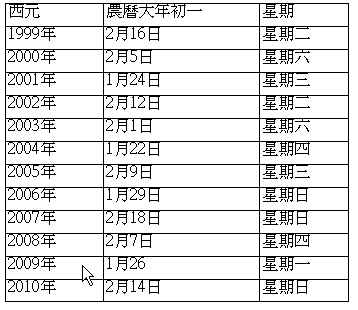
表八:1999年至2010年大年初一的日期
八、結語
我國的曆法採用陰陽合曆,比起其他國家所採用的純陽曆或純陰曆都要精準,這是一門科學必備的條件與精神。曆法與我們的生活息息相關,古代用來「日出而作,日入而息。」,或用來作為祭祀的依據,表示對大自然的尊敬,對祖先的懷念;現代人用來作為爭取放假的依據,討論廿一世紀的第一道曙光在哪裡看?後來說,2000年與2001年都叫千禧年,因為這樣可以辦兩次觀賞日出的活動。
現在學校也將寒假開始的日期固定在元月20日前後,藉以將過年的日期涵蓋在寒假當中,同時解決第一學期較長的問題。今年(2004)許多學校的行事曆,都把清明節的假日訂在四月五日(星期一),準備賺它一天假期,但是後來都發現今年的清明節其實是四月四日(星期日)而臨時取消假期。天文與曆法對生活仍帶來很大的影響。 -
表七:1988年-2010年的冬至日期
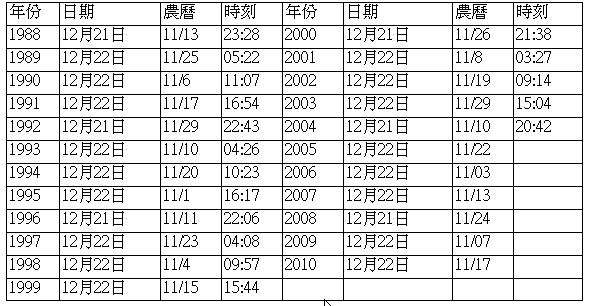
☆以上數據摘錄自台北市立天文台出版之天文年鑑。七、明年(2005)二月9日過年!
基於上述農曆曆法的原則,我們以最近幾年的過年來說明。1999年2月16日(星期二)大年初一。因為十二個月的農曆比陽曆少了11天(365-354=11天),因此2000年的過年必須往前推十一天,在2月5日(星期六)過年。再來因為2000年是閏年(二月有29天)、以及月亮運動速率的影響,2001年必須往前推十三天,在1月24日(星期三)就已經過年了。以往都在寒假期間過年,學校也沒有春節的放假問題,現在移到寒假之前,學生將多放了好幾天假,問題是過完年後再參加學校的期考,應該多少會影響成績吧?所以學校的行事曆上已經排定元月21日起放寒假,趕快規劃出國行程吧!該年(2001年)六月份,農曆是閏四月,把2002年的過年往後推19天(每年陰曆比陽曆少11天,共差30天),2002年二月12日(星期二)是大年初一,寒假過年,學生沒賺到假期;2003年又必須往前推十一天,2月1日(星期六)是大年初一,學生只賺到除夕的假期;到了2004年四月份,雖然又多了一個閏二月,但來不及將過年往後推,1月22日(星期四)就過年,學生又賺到了。沒關係,這個閏月把明年的過年向後推29天,又因為農曆比陽曆少了11天,日期向後推18天,2005年2月9日過年。2006年再往前移11天。 -
表六:占星術的星座日期與目前實際日期對照表
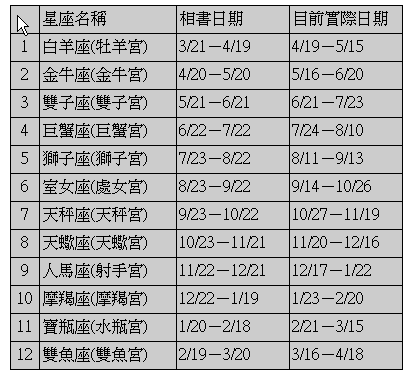
◎註:占星術用的黃道十二宮為二千多年以前巴比倫人所發明,原理主要以太陽所到的黃道星座為日期。例如今天(6/15)的太陽位於雙子座,那麼當天出生的嬰兒就屬於雙子座;據此評斷該嬰兒的個性及未來。改良式的星座相命,還增加月亮及行星的位置,比較複雜,也可能比較準確吧!然而因為地軸的進動現象,今天太陽所在的星座位置已經改變,若不是占星術要有一定的修正方式,就是以前的原理有問題了。□冬至的日期
最近元月份的月考,某國小四年級的國語科試題有一題:「冬至是哪一天?」,沒有十二月的選項,老師的答案是十一月(十五日)。我們知道冬至在十二月22日附近,那是以太陽到達黃道經度(視黃經)270度的時間為準,而地球運轉的週期也能精確測得,一年有365.2422天,因此,每年太陽到達冬至點的週期幾乎相同,並完全以太陽的運行(其實是地球在運動)為標準,與月亮或農曆一點關係也沒有。
但因為一年的週期多了0.2422天的非整數,因此每年的冬至都要往後延大約將近六個小時(也就是0.2422天);另外還有歲差的影響,會使廿四節氣逐漸往前移(請參閱:為什麼清明節的日期會變動?)。到了閏年(1992、1996、2000),二月份多了一天,以消除非整數的誤差,使二月以後的日期都後退一天,也就是使冬至提前了一天,今年(2004)的冬至在十二月21日的晚上8:42(如表三)。以下表列近十數年的冬至日期供作參考: -
表五:九十三至九十四年(2004-2005)滿月(望)日期與時刻表
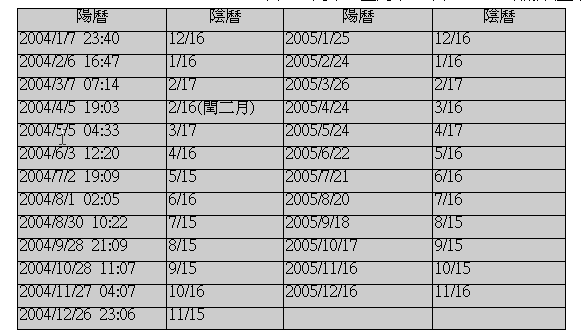
註:2003年到2005年資料為鄭文光老師統計。
六、為什麼清明節的日期會變動?
清明節的日期是以清明的節氣為準。因為歲差的影響,使春分點逐漸移動,每個節氣的日期逐年往前移。根據統計結果:西元1901年至1943年間,清明節的日期為四月五日或六日;1944年至1975年間,清明節是四月五日;1976年至2000年則為四月四日或五日。2000年以後,閏年的清明節為四月四日;平年就在四月五日。今年(2004)是閏年,清明節落在4月4日(18時43分)。
由於地球繞太陽公轉時,地球的自轉軸受到日、月引力的影響,而在空中做錐形運動,也就是物理學上所謂的進動(precession)現象,而造成歲差。陀螺的自轉軸便是典型的進動現象。歲差現象使地軸在黃極轉圓圈,週期大約25800年,春分點平均每年後退五十弧秒;現今太陽運行,每月占據的黃道十二星座,與三千多年以前發明的占星術,太陽所占據的星座已經不同(占星學6/15屬雙子座,今日星座為金牛座);北極星也逐漸移動,在公元一萬四千多年以後,織女星將成為北極星。
